An Urban Vision for LRT
The city just unveiled a consultant’s report with a high-level vision for the long-term LRT network, which aims to take rapid transit to all corners of the city, though with a different flavour than we’ve known until now. Council will hear from the public and debate these recommendations at the Transportation and Public Works Committee on June 2.
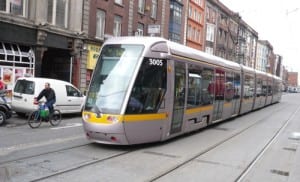
I took this picture of the sleek and popular LUAS LRT while on vacation in Dublin in 2008.
With a general consensus that our city needs to ‘grow up’ instead of ‘grow out’ (or at least achieve a better balance of infill redevelopement and intensification versus so-called ‘greenfield’ development) the consultants have recommended that Edmonton develop an LRT with an ‘urban’ feel, instead of the more ‘suburban’ system we’ve been developing.
The key differences between an urban and suburban system is the separation between stations: suburban system stops are up to 2.5km apart, whereas urban system stations are 400-800m apart. The advantage of the urban style is that you begin to develop corridors of density, where the density is spread more evenly along the LRT, rather than in isolated nodes. The tradeoff is that travel long distances on the LRT takes a bit longer, but if our end goal is to build the core, not encourage more suburbs, then urban style is the way to go.
This does mean LRT out to the International Airport and for example, Spruce Grove is less likely, but LRT technology was never well suited to that since it’s top speed is 80km/h and since electrification is most efficient with frequent stopping and starting, not long runs. A fast rail or bus link to our urban LRT system is more appropriate for getting out to the region. Where we’re contiguous, as with St. Albert, an argument can still me made to connect with LRT; Sherwood Park as well, in time.
I am hopeful that if these recommendations are approved by Council that the argument for a station near Harry Ainlay at 40 Ave on 111 St will gain traction, understanding however that it would come with some redevelopment as well.
The other key recommendation is to look at a ‘low-floor’ style of system for the West, East and and Southeast lines. These board from the curb and are much less infrastructure-heavy. Low-floor LRTs are not streetcars because they still run in their own right of ways, but those right of ways are cobbled or sometimes even vegetated, as opposed to the great grey swaths that we’re used to.
Having ridden the Dublin low-floor system last year I can attest to the lovely sense of appropriate scale as it worms its way through the city, stopping frequently enough to have an impact but without disrupting the underlying feel of the city.
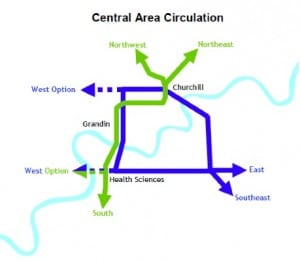 The recommendations call for a shift in the bus service to feed the LRT and connect the ‘spokes’ with better crosstown service.
They also call for looking at building a ‘central area circulation’ by connecting the University Area on the South LRT with Bonnie Doon on the SouthEast LRT via Whyte, which is very exciting in my mind — finally recognition that the core of the city spans the river and includes both Downtown and University/Strathcona.
What do you all think of it?
Did these consultant reports give any hint to how much added cost (direct and indirect, these studies are notorious for ignoring loss of utility of appropriated land like the houses bulldozed on 114th at Univ. Ave) we could be looking at and what sort of projected ridership is anticipated?
An underground LRT at Whyte Ave is a decent idea, but it won’t do us much good if the trains stop at midnight. Too much of these proposals centre around what city planners think people should do, versus what they actually do do. Par example, how does the Dublin low floor system’s ridership drop when the temperature is below -20C?
Concept level costs are in the detailed report we saw. Without a specific routing we can’t compare detailed costs. $6-$9 billion over 15-20 years is the range we’ve heard.
What we’ve been told is low-floor is cheaper to build but more expensive to operate. Meanwhile, more stations are more expensive to build but generate more trips, and therefore more revenue.
If low-floor runs down an existing roadway (and you give up car lanes) then there’s little to no land acquisition cost.
I can’t speak to the ridership trends in cold weather in Dublin, but I don’t think it gets that cold there, which might be your point. The conventional wisdom is that people will wait outside in almost any weather if they can expect a ride in 5 minutes or less. Certainly you can still put shelters on the raised curb, see: TTC LRT concept image.
This is a great post. I’ve traveled a lot in Europe and there are great systems in a number of cities there that combine low-floor LRT with buses and trains. I think Edmonton needs to develop an integrated plan that makes sense for different sorts of users and I think it’s great that this idea integrates the downtown and University/Strathcona area as one core. I am very excited to see this kind of thinking happening here.
I do like some of the concepts that the transportation department and its consulting team are bringing forward.
About the TOD part, I’m not so sure. In Portland, often cited as a model of a sustainable city, communities served by LRT have become gentrified and almost exclusively adult-living. Many analysts concluded that TOD actually accelerated urban sprawl, as families were nudged to the suburbs, the only place where housing suited for them was being built.
In Edmonton, we seem to be making the same mistakes:
– Most densification involves units intended to be lived in by one or two people, impractical for families.
– By far the majority of new buildings have rules that prohibit anyone under 18 from living in them.
– Developers don’t include courtyard green space where children can play, or amenities such as playrooms and daycares.
– A condominium downtown costs more than a single-family house in Lewis Estates.
– Schools in mature communities are closing while new ones are opening in suburbia.
Many young parents want to make positive housing choices that are ecologically responsible. There is nothing in TOD or more generally in Smart Choices that responds to the needs of families or recognizes that their flight to suburbs is the greatest “green” challenge facing this city.
LRT along Stony Plain Road may do more to transform the area into an adult-living neighbourhood than the much-discussed peep shows.
I couldn’t agree more, Christopher, that nothing is served if we create demographic monocultures around LRT stations. This is happening downtown already. I’m having some discussions with people in Planning and in industry about the missing link, which I think is the family-supportive townhouse. It’s land-efficient and family friendly. It might not be on the same street as the station, but it’s what should be popping up on the next several blocks but first we need to remove some barriers in our process while ensuring that what gets built adds to a neighbourhood. I’m actively working on this question.
While Dublin doesn’t get down to -20 in winter, it does feel surprisingly cold in early January due to the humidity. And people still seem to wait for the LUAS.
It’s struck me for a while that Whyte (say, going from 112th at University Station out to 99th initially, with a subsequent extension to Bonnie Doon) is ideal for a streetcar-style line. It probably doesn’t make sense to completely isolate the right of way there, but running it down the centre (e.g. San Francisco, Rome) with stops every few blocks would work well and free up busses.
And yes, low-floor trains are absolutely the way to go.
I’m disappointed to hear that the airport would be excluded in your proposed process. One of our favorite cities is Chicago and we ride the subway directly from the airport to downtown(approx 35 min.). It would put an end to all of the arguments about keeping the municipal downtown airport open due to the cost and inconvenience of travelling to the International airport. Edmonton does not need two airports; it just needs effective access to one airport. An LRT extension would provide that. The extension to the airport is less expensive to do before the land involved becomes infilled with housing and other construction. Just as was done with the old rail yards north of 104 Ave, the municipal airport land can be turned into a positive and vibrant part of the centre of our city.
Brent, I didn’t say we shouldn’t connect something to the International Airport, just that our LRT system might not be the best link out there. Ask yourself: would you rather take a fast train and transfer to the LRT half way or take a slower train the whole way? The answer might well be the slower train, but if the cost to the public and/or the rider was several times higher for the slower single train, which would you pick?
this is my number one concern for edmonton.
it touches on almost all other major issues this city faces. urban sprawl, transportation, environment, urban revitalization, poverty, ect.
please make sure we don’t see public transit be ignored ever again in this city… it’s about time this city starts acting like a city, and stops pretending to be a big town
I would suggest that your links open in another page. I tried to access two links off of this page to not have them open at all.
Good tip, Jim. I was doing this and then got out of the habit. Will get back into it.
Don,if the map above is anything to go by the proposed Central Area Circulation would be environmentally destructive as it would require two new crossings of the North Saskatchewan River Valley. The bridges would have to rival the height of the High Level Bridge if the lines are at street level. Such a circulation area would also create traffic chaos, and safety issues for pedestrians and cyclists, throughout the Downtown and Whyte Avenue areas.
Central Area Circulation via a tram (it’s not really LRT because it’s not rapid transit) is also completely unnecessary and redundant. Already in place is the underground LRT tunnel connecting the highest density zones in the central area (i.e. the University/Health Sciences area, the Legislature/Government Centre area, and the Downtown core). Once the NAIT line is completed there will be further connections to MacEwan College, the Royal Alex and NAIT. To complete the circulation, the #7 bus already connects the Churchill and Central LRT stations via Scona Road and Whyte Avenue to University Station with a 15 minute frequency during peak periods. I’m sure bus service frequency could be increased if warranted by passenger demand.
John, my reading of the central area circulation notion is different than yours. The text and the consultant presentation focused on connecting the lines. It does not prescribe all the lines on the map, just illustrates some of the different ways you could achieve a crisscrossing triangle rather than relying on downtown to be the hub for all the lines. Central area circulation just means seeing whether there’s a way to link the SE and SW lines down Whyte. This could tie in to an eventual East line out to Sherwood Park and/or an 87th Ave alignment for Westbound. Or it could just connect from U of A to Bonnie Doon, possibly as a Tram system, but certainly as a bus in the interim to establish the pattern of travel. Circulation refers to the ability to circulate as a passenger, not necessarily having a loop superimposed on all the other lines.
So there’s no guarantee of any additional bridges. Other route selection would drive that decision, I think. And if there are bridges, we can sill tunnel down to a mid-height crossing, so it’s not automatic that they would be high viaducts, though from a pedestrian and cycling use perspective that has merit.
Excellent post, great ideas and concept. I may have judged too harshly based on the LEGO post.
TOD hasn’t been a resounding success in many places (Edmonton included) however some of that is a cultural or social issue. It is my belief that many of the passengers of LRT/ETS in Edmonton use it strictly to commute from home to work and nothing more. Thus TOD is nearly impossible in it’s most efficient forms because many of the potential riders (home owners rather than renters) drive the type of development around transit and ask for low density or car parking so they can continue to maintain a suburban type lifestyle with the advantage of transit to get to work.
(I read the post on Park and Ride) I believe that the city needs to take a brave step and say NO to ‘park and ride’ at Century Park and other LRT stations and encourage development of affordable properties nearby, not parking lots. In fact placing a parking structure across the street from the housing (Century Park example) and developing more high density residential with street (or sidewalk) level commercial alongside or incorporating the actual LRT station might actually help grow the area as a neighborhood, get people on the streets (or sidewalks) and help that commercial remain viable and
the residential remain safe, affordable, and accessible. It doesn’t matter how much or little parking costs, it is still a parking lot and people can’t pay any amount of money to live that close to transit unless there is housing there.
regarding the Ainlay stop – I spoke to an ETS planner and he basically restated the case that they can’t justify a stop which only serves one small population and only for a very limited amount of time (school days, between 8 and 4, ~200 days a year). Perhaps pedestrian bridges to the Southgate stop would be a good compromise.
Anyways, you’re pretty convincing with the why of low floor systems, it does seem to complement the type of compact development which is more desirable for the City of Edmonton.
Congrats on being re-elected, have a great term, keep blogging.